
Introduction
Cybersecurity threats are becoming more advanced every year. Attackers are no longer relying only on simple password attacks. Phishing, credential theft, account takeover, MFA fatigue, and AI-powered social engineering are creating new challenges for businesses.
Multi-Factor Authentication (MFA) remains one of the most important security controls. However, the way organizations use MFA is changing.
Traditional Static MFA often applies the same authentication requirement to every login. This can create unnecessary friction for legitimate users while not always providing enough protection when a login is genuinely suspicious.
This is where Adaptive MFA, also known as Risk-Based Authentication (RBA), becomes important.
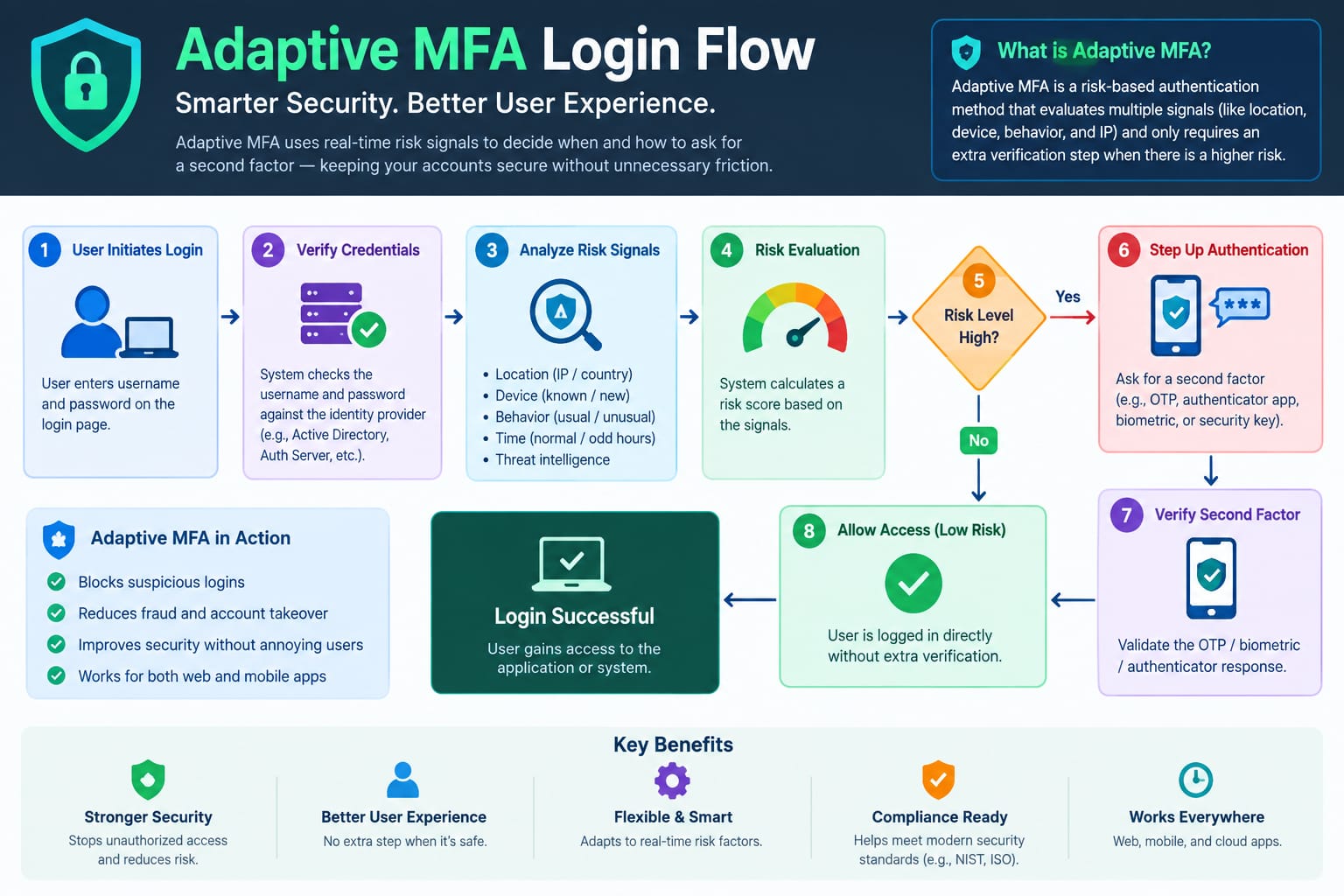
Instead of treating every login equally, Adaptive MFA evaluates the context and risk of each authentication attempt. Based on that risk, it can allow access, request additional verification, or block the login.
The goal is simple:
Low-risk activity should remain convenient, while high-risk activity should receive stronger protection.
What Is Adaptive MFA?
Adaptive MFA is an authentication approach that changes the level of verification based on the risk associated with a login attempt.
For example, imagine an employee normally accesses company applications from a trusted laptop, during normal working hours, using a familiar network.
The login matches the user’s normal behavior, so the system may allow access with minimal additional verification.
Now imagine the same account attempts to log in from an unfamiliar device, unusual location, and suspicious network.
The system can identify these signals and increase the authentication requirement.
Depending on the organization’s security policy, the user might be asked to complete step-up authentication, such as a biometric check, passkey, security key, or another strong authentication method.
This makes authentication more context-aware and risk-sensitive.
How Is Adaptive MFA Different From Static MFA?
Traditional Static MFA generally follows a fixed rule:
Username + Password + MFA = Access
The same process may be applied whether the login comes from a trusted office device or an unfamiliar device in a high-risk situation.
Adaptive MFA follows a different approach:
Username + Password + Risk Assessment → Authentication Requirement
The authentication requirement can change depending on the circumstances surrounding the login.
For example:
Login Situation| Risk Level| Possible Action
Known device + normal location| Low| Low-friction access
New device + normal location| Medium| Additional verification
Unknown device + unusual location| High| Strong authentication
Suspicious device + threat intelligence alert| Very High| Block or investigate
This approach allows security teams to apply security controls according to the actual risk instead of using one fixed rule.
What Signals Can Risk-Based Authentication Evaluate?
A major advantage of Risk-Based Authentication is that it can analyze multiple signals before making an authentication decision.
These signals can include:
- User Location
A login from a user’s normal location may be considered lower risk.
An unexpected login from a completely different geographic location may increase the risk score.
- Device Information
The system can check whether the user is accessing the application from a known, trusted, or managed device.
A new or unknown device may require additional verification.
- Login Behavior
Unusual login patterns can indicate that an account may have been compromised.
For example, repeated failed login attempts followed by a successful login could increase the risk level.
- Time of Access
A login at an unusual time may increase the risk score depending on the organization’s normal working patterns.
For example, an account normally used during business hours suddenly attempting access at an unusual time may require additional verification.
- Network Information
The authentication system can analyze information about the network and connection.
Suspicious IP addresses, unusual networks, or other threat signals can influence the risk decision.
- Previous Activity
Historical authentication and access behavior can help establish what normal activity looks like for a particular user.
By combining these signals, RBA can make more informed authentication decisions.
Why Are Businesses Moving Toward Risk-Based Authentication?
Modern organizations no longer operate from a single office network.
Employees may work from:
- Office networks
- Home networks
- Mobile devices
- Different geographic locations
- Cloud applications
- Managed laptops
- Remote environments
At the same time, businesses use multiple SaaS applications and cloud services.
A fixed authentication policy may not accurately represent the risk of every access request.
Risk-Based Authentication allows security teams to increase protection when suspicious conditions appear while keeping normal authentication simple.
This is particularly useful for organizations that are adopting cloud security, Zero Trust, and modern identity security strategies.
Improving Security Without Creating Unnecessary Friction
Security is important, but excessive security prompts can create problems for users.
If employees receive authentication requests too frequently, they may experience MFA fatigue.
MFA fatigue occurs when users receive repeated authentication prompts and may eventually approve a request without carefully checking whether they initiated it.
Adaptive MFA can help reduce unnecessary prompts by focusing stronger authentication on higher-risk situations.
Normal Login
Known device + expected location + normal behavior → Lower-friction authentication
Suspicious Login
Unknown device + unusual location + abnormal behavior → Stronger authentication
This approach can improve both security and user experience.
Adaptive MFA and Zero Trust
Adaptive MFA fits naturally into a Zero Trust security model.
Zero Trust follows the principle that access should not automatically be trusted simply because a user is inside a corporate network.
Instead, every access request should be evaluated based on its context and risk.
Security teams may consider questions such as:
- Who is requesting access?
- What device are they using?
- What application are they accessing?
- What resources are they requesting?
- Is the device secure?
- Does the user’s behavior look normal?
- What is the current risk level?
Adaptive authentication can provide an important layer within this broader Zero Trust security strategy.
Can Adaptive MFA Prevent Account Takeover?
Adaptive MFA can help reduce the risk of account takeover, especially when attackers have obtained a user’s username and password.
For example, an attacker may have a valid password but attempt to log in from an unknown device and suspicious network.
The risk engine can identify these unusual signals and request stronger verification or block the login.
However, Adaptive MFA is not a complete cybersecurity solution.
Organizations should combine it with other security controls, including:
- Strong identity management
- Least-privilege access
- Endpoint security
- Security monitoring
- Phishing protection
- Security awareness training
- Incident response
- Threat intelligence
A layered security approach provides stronger protection than relying on a single control.
The Role of AI in Modern Authentication
Artificial intelligence and machine learning are becoming increasingly useful in modern identity security.
Security systems can analyze large amounts of authentication and behavioral data to identify unusual patterns.
For example, an employee may normally access a small number of business applications.
If the account suddenly attempts to access several unfamiliar applications or sensitive resources, the system may identify this as unusual behavior.
These signals can contribute to a more dynamic risk assessment.
However, AI should support security decisions rather than replace security policies, proper configuration, and human oversight.
Phishing-Resistant Authentication and Adaptive MFA
Another important development is the growth of phishing-resistant authentication.
Traditional SMS-based verification can be vulnerable to certain attacks, including phishing and SIM-swapping.
Organizations are increasingly adopting stronger authentication technologies such as:
- Passkeys
- FIDO2
- WebAuthn
- Hardware security keys
- Platform biometrics
These technologies can provide stronger protection against phishing.
Adaptive MFA can use these stronger methods when a login requires additional verification.
This creates a useful combination:
Risk detection + phishing-resistant authentication = stronger identity security
Static MFA Is Not Going Away—But It Is Evolving
It would be incorrect to say that traditional MFA is no longer useful.
MFA remains an important defense against credential-based attacks.
The change is that organizations are increasingly looking for authentication systems that are:
- Context-aware
- Risk-sensitive
- User-friendly
- Integrated with identity security
- Capable of responding to changing threats
Adaptive MFA builds on the foundation of traditional MFA while making authentication decisions more dynamic.
The future is not necessarily about replacing MFA. It is about making MFA smarter and more responsive to risk.
How Businesses Can Get Started With Adaptive MFA
Organizations can introduce Adaptive MFA through a structured approach.
Step 1: Understand Your Current Authentication Environment
Identify the applications, users, devices, and authentication methods currently being used.
Step 2: Identify High-Risk Access
Determine which applications, accounts, and resources require the strongest protection.
For example, financial applications and administrative accounts may require stronger authentication than low-risk internal applications.
Step 3: Define Risk Signals
Decide which signals should influence authentication decisions.
These may include device status, location, network information, login behavior, and previous activity.
Step 4: Create Authentication Policies
Define what should happen at different risk levels.
For example:
Low Risk → Normal authentication
Medium Risk → Step-up authentication
High Risk → Block or investigate
Step 5: Monitor and Improve
Regularly review authentication events, security alerts, false positives, and user feedback.
Risk policies should evolve as the organization’s environment and threat landscape change.
Key Benefits of Adaptive MFA
When implemented correctly, Adaptive MFA can provide several benefits:
Better Security: Suspicious authentication attempts receive stronger controls.
Less User Friction: Normal users may experience fewer unnecessary MFA prompts.
Better Account Protection: Unusual access attempts can trigger additional verification.
Support for Zero Trust: Authentication decisions can become part of a broader risk-based access strategy.
Improved User Experience: Security requirements can be matched to the situation instead of applying the same process everywhere.
Modern Identity Security: Organizations can combine risk analysis with stronger authentication technologies such as passkeys and FIDO2.
Final Thoughts
Cybersecurity in 2026 requires organizations to think beyond simple username-and-password protection.
Multi-Factor Authentication remains essential, but the way organizations use MFA is evolving.
Adaptive MFA and Risk-Based Authentication allow security teams to evaluate the context of each login and determine how much authentication is actually required.
Instead of asking every user to complete the same verification process every time, organizations can apply stronger controls when the risk is high and reduce unnecessary friction when the activity appears normal.
The future of authentication is not simply about adding more security steps.
It is about making those security decisions smarter, more contextual, and better aligned with actual risk.
For businesses building a modern identity security strategy, Adaptive MFA can work alongside Zero Trust, phishing-resistant authentication, identity management, endpoint security, monitoring, and continuous risk assessment.
Looking to strengthen your organization’s identity and access security? Managed Cyber Hub can help organizations evaluate modern cybersecurity and identity-security strategies based on their specific environment and requirements.
Latest News
Adaptive MFA in 2026: Why Risk-Based Authentication Is Replacing Static MFA
Introduction Cybersecurity threats are becoming more advanced every year. Attackers are no longer…
Hello world!
Welcome to WordPress. This is your first post. Edit or delete it, then start writing!…